Crusoe today announced the launch of Command Center, a unified operations platform that provides a data foundation for massive AI workloads and increases the resilience of the AI stack.
Command Center creates a single source of truth that provides deep observability into AI workloads for monitoring, diagnosing and optimizing AI workloads, the company said in its announcement. Command Center is integrated with Crusoe Managed Kubernetes (CMK), Auto Clusters and Crusoe Managed Slurm to provide greater transparency and faster triage to maximize every GPU hour, the announcement read.
“For AI builders, every hour spent manually triaging a stalled GPU or hunting through fragmented logs is an hour lost on model innovation,” Nadav Eiron, Senior Vice President of Engineering for Crusoe Cloud, said in the statement. He went on to say that Command Center helps engineers by “removing the operational tax of high-performance computing and allowing engineers to spend less time acting as mechanics and more time as architects of the AI future.”
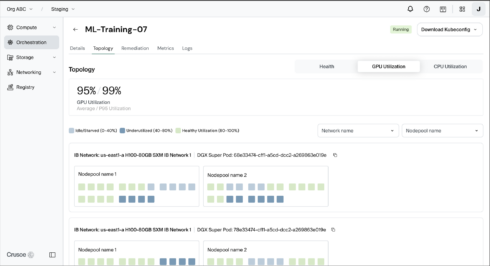
Among the features in Command Center to help reveal the issues that impact velocity are out-of-the-box GPU telemetry, support for custom metrics by pairing Command Center with the Crusoe Watch agent, streaming infrastructure metrics into existing observability stacks, and a topology view that the company said “enables engineers to diagnose issues by visualizing exactly where a failure sits within the cluster’s physical or logical architecture.” A feature now in preview offers correlation of hardware metrics with system logs into a single view so engineers can quickly determine root causes of issues.
Further, the company wrote, critical alerts and remediation events can be streamed from a new Notification Center into Slack and other webhooks, eliminating the need for ticket-driven SLAs and ensuring issues are addressed as they occur. The Notification Cetner are now delivered directly in-console or streamed via a new Notification Center to Slack and other webhooks.